
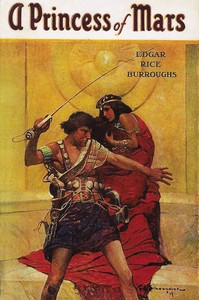
A princess of Mars — Background and Themes
Edition facts
The narrative of A Princess of Mars opens with a frame story: a foreword by an unnamed editor who recalls Captain John Carter as a tall, laughing Virginian, a "splendid specimen of manhood" with steel-gray eyes. This measured, almost biographical tone contrasts sharply with the breakneck action that follows once Carter is transported to Mars. Burroughs uses the first-person voice to create immediacy in battle scenes—"With my back against a golden throne, I fought once again for Dejah Thoris"—while the pacing slows considerably during Sola's harrowing account of her mother's torture and death. The novel thus alternates between breathless combat and reflective, almost Gothic storytelling, a structural rhythm that rewards attention to shifts in tempo.
Voice and the Frame Narrator
The foreword establishes a narrator who knew Carter personally, describing him with the affectionate distance of memory. Phrases such as "he seemed always to be laughing" and "his courtliness was that of a typical southern gentleman" ground the fantastic tale in a recognizable, almost nostalgic American past. This voice returns only briefly at the end, creating a bookend that reminds the reader the story is being told after the fact. The effect is a layering of perspectives: the editor's calm, retrospective tone versus Carter's urgent, present-tense adventures. Pay attention to how the editor's voice colors the credibility of Carter's claims—he presents the manuscript without judgment, letting the reader decide.
Pacing and the Shift to Sola's Story
Chapters XV through XVII mark a pronounced change in pace. After a series of duels, escapes, and chases, the narrative slows as Sola recounts her mother's imprisonment and death. Her speech is measured, filled with detail: "the lesser moon swung clear of the overhanging roofs," "she slipped stealthily in upon the trailing tailboard." The emotional weight of this section—torture, betrayal, a mother's sacrifice—contrasts with Carter's earlier physical exploits. Burroughs uses Sola's story to deepen the world-building and to introduce a tragic backstory that reframes the Thark culture. The pacing here is deliberate, almost novelistic, and rewards readers who attend to the shift from action to interiority.
Recurring Details and Structural Echoes
Burroughs repeats certain motifs across the excerpts: the "golden throne" appears in both the illustrations list and a battle scene; the act of drawing a map on marble floor recurs as a key moment of knowledge transfer. These details create a sense of cohesion across the episodic structure. The setting also echoes: the Arizona cave that opens the story is mirrored by the "At the Arizona Cave" chapter closing the book, suggesting a circular journey. Similarly, the phrase "the only pass through the hills" in Sola's story echoes the geography of Carter's early escape. These structural echoes reward a careful reader who notes how the landscape of Mars mirrors the American Southwest.
Readers may find it useful to track the shifts in narrative speed: the breathless action of Carter's first-person account versus the slower, more reflective passages told by or about other characters. The novel's structure rewards attention to these changes, as they often signal a shift from external conflict to internal revelation. Consider how the frame narrator's voice frames the entire tale, and how the recurring motifs of maps, thrones, and caves tie the Martian adventure to Carter's earthly origins.