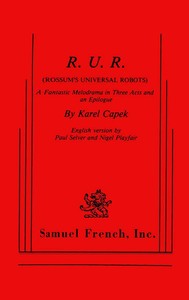
R.U.R. (Rossum's Universal Robots) A Fantastic Melodrama in Three Acts and an Epilogue — Story, Setting & Ideas
Edition facts
The play opens not with a whir of machinery but with a conversation about the absence of children. Helena asks Dr. Gall why no more children are being born, and his answer ties human extinction directly to the manufacture of Robots: 'so many Robots are being manufactured that people are becoming superfluous.' This early exchange establishes the central tension—between biological reproduction and industrial production—that runs through the three acts and epilogue. Čapek does not let the audience settle into a simple technophobic fable; instead, he layers corporate pressure, scientific curiosity, and a quiet act of destruction that may or may not change the course of events.
The Burning of the Manuscript
One of the most striking scenes in the excerpt shows Helena burning old papers—'fearfully old'—in a fireplace during summer. She asks Nana whether she would burn 'the greatest invention in the world' if it were money, and Nana replies without hesitation: 'I'd say burn it. All these new-fangled things are an offense to the Lord.' Helena watches the flames, describing them as 'like hands, like tongues, like living shapes,' and then immediately regrets her action: 'Whatever have I done?' The scene is dense with ambiguity. The papers are old Rossum's manuscript, the formula for making Robots. Helena destroys it, but the reader never learns whether this act will have any effect—whether the Robots can still be reproduced without it, or whether the damage is already done. Čapek leaves the consequences unclear, forcing the audience to sit with the uncertainty of a gesture that may be heroic, futile, or catastrophic.
Competing Pressures: Shareholders, Governments, and Scientists
Dr. Gall's explanation to Helena reveals a world driven by conflicting demands. The R.U.R. shareholders 'won't hear of' restricting production; governments clamor for more Robots to strengthen their armies; manufacturers order 'like mad.' Meanwhile, universities petition for limits, warning that mankind will become extinct 'through lack of fertility.' No one, Dr. Gall says, has the courage to demand a complete halt—'People would stone him to death.' The dialogue exposes a systemic trap: convenience and profit override long-term survival, and even those who see the danger feel powerless. Čapek does not offer a single villain; instead, he shows how economic, military, and social structures collectively drive toward collapse. The play's subtitle, 'A Fantastic Melodrama,' may seem ironic given the cool rationality of these arguments, but the melodrama emerges precisely from the gap between clear-eyed diagnosis and collective inaction.
The Language of Manufacture and the Absence of the Human
Throughout the excerpt, the vocabulary of production dominates. Robots are 'manufactured,' 'produced,' 'ordered.' People become 'superfluous,' a 'survival' after 'a paltry thirty years of competition.' Dr. Gall speaks of Nature being 'offended at the manufacture of the Robots,' as though the natural order itself has been violated. Yet the Robots themselves are barely described as individuals; they are a mass, a force, a problem. Even Radius, mentioned only in passing by Nana as 'that mad Radius,' remains offstage. This linguistic choice mirrors the dehumanization at the play's core: the Robots are treated as products, and humans are becoming statistical redundancies. Čapek's dialogue is economical, each line carrying weight. When Helena asks, 'And yet you go on making Robots!' the exclamation point does more work than any lengthy speech could. The play's power lies in what is not said—the missing children, the burned formula, the laughter of men offstage while a world ends.
Readers approaching R.U.R. should attend to the play's stage directions and offstage sounds as closely as its dialogue. The laughter of men, the crackling of a fire, the absence of children's voices—these details build an atmosphere that the characters themselves often fail to read. Čapek's play is not a technical prophecy but a dramatic exploration of how systems of production and consumption can override human instinct. The word 'robot' was born here, but the play is less about machines than about the people who build, buy, and burn them.