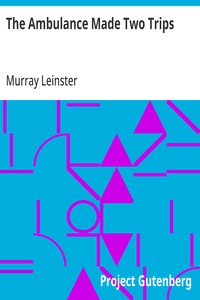
The Ambulance Made Two Trips — Reading Companion
Edition facts
The story opens not with a crime scene but with a meerschaum pipe left on a detective's doorstep alongside the milk. This mundane detail sets the tone for a narrative that treats police work as a battle of wits against an unconventional form of corruption: anonymous gifts that erode integrity without explicit bribery. Detective Sergeant Fitzgerald, the protagonist, immediately donates the pipe to an orphanage, establishing his resistance to the gangster Big Jake Connors's strategy. The gifts—ranging from Scotch to silk socks—are described with a specificity that grounds the story in material reality, even as the plot veers toward the absurd.
The Mechanics of Corruption
The story's structure hinges on a peculiar form of bribery: gifts that arrive without strings attached, yet create a moral debt. Fitzgerald notes that a police lieutenant's wife received a mink stole, and when he donated it, she didn't speak to him for ten days. Another sergeant found four new white-wall tires on his doorstep and faced ostracism from his children after turning them in. These vignettes, delivered in Fitzgerald's brooding internal monologue, illustrate how the gifts exploit personal relationships and social pressure. The gangster never asks for favors, but the recipients' gratitude—and their families' resentment—gradually undermines their willingness to act against him. Leinster builds the plot around this psychological mechanism rather than direct threats, making the conflict one of attrition rather than violence.
A Chain Reaction of Accidents
The story's centerpiece is a meticulously choreographed sequence in a dry-cleaning plant. When two hoods corner Fitzgerald, he throws a box of spot-remover at a dryer. The box dents the door, which flies off, hits one hood's gun, and knocks it away. The door then slams into a partition, causing shelves to shed detergent, light bulbs, and other items. One hood sneezes from dust, bends over, and jars the partition further. A two-gallon jar of detergent conks him, and he fires wildly. The bullet ricochets, and the second hood slides across detergent-slicked floor oil—a surface Leinster describes with pseudo-scientific precision: "coefficient of friction of a really good detergent on top of floor-oil is remarkably low,—somewhere around point oh-oh-nine." The sequence reads like a physics problem turned into comedy, with each action producing an unexpected but logical outcome.
Slapstick Physics and Visual Humor
Leinster's prose revels in the physical details of the chaos. The sliding hoods are described with deadpan exaggeration: one "slid magnificently on his belly on the superb lubrication afforded by detergent on top of floor-oil," while the other "remained erect, but he slid slowly along that shining path" despite running frantically. The narrator notes that his "legs twinkled as he ran" but his feet slid backward, creating an image of dignified futility. The scene culminates in a cloud of bone-black from burst drums, turning the garage into a black fog. This blend of technical jargon and slapstick recalls the work of Rube Goldberg, but Leinster grounds it in the specific environment of a dry-cleaning plant—a setting chosen for its industrial hazards. The humor arises not from character wit but from the collision of objects obeying physical laws in absurd combinations.
Voice and Narrative Distance
The story is told in a third-person voice that stays close to Fitzgerald's perspective, filtering events through his "gaping" and "nerveless hand" as he watches the accident unfold. The narration adopts a colloquial, slightly ironic tone, as when it describes the gifts' effects: "The presents weren't bribes. Big Jake not only didn't ask acknowledgments of them, he denied that he was the giver." This creates a sense of weary familiarity with corruption. The prose also shifts into mock-scientific register during the accident, with phrases like "coefficient of friction" and "implode" used for comic effect. The structure alternates between Fitzgerald's internal reflections and external action, with the long accident sequence serving as a set piece that resolves the plot through farce rather than deduction. The story's brevity—under 11,000 words—keeps the focus on this single, escalating incident.
Readers should pay attention to how Leinster uses the dry-cleaning plant's equipment as both setting and plot device. The story's humor depends on the precise arrangement of objects—dryer, detergent, floor oil—that turn a potential shootout into a comedy of errors. Fitzgerald's role as observer rather than instigator of the chaos underscores the story's theme: that corruption can be undone by accident as easily as by design. The title, referring to the ambulance's two trips, hints at the aftermath, but the excerpts leave the final outcome unclear, inviting speculation about how the gangster's scheme ultimately unravels.