Robinc — Edition Insights
Edition facts
The story opens with a blunt, colloquial voice: “You’d think maybe it meant clear sailing after we’d got the Council’s O.K.” The narrator, a Robinc repairman, immediately establishes a contrast between his pragmatic cynicism and Dugg Quinby’s idealistic faith in people. The Head of the Council warns that politics, like love and music, is a permanent human activity—and that Quinby’s directness may not prevail. This sets up a tension between straight-looking problem-solving and the crookedness of human motives.
A Narrator Who Counts in Halves
The narrator’s voice is distinctive: self-deprecating, slangy, and prone to fractured arithmetic. At one point he says, “I know that makes three halves of me, but I was in no state for accurate counting.” This offhand remark captures his mental disarray during a crisis, but also signals a recurring pattern—the narrator measures himself in odd fractions, as if his identity is split between self-interest and an unexpected loyalty. He admits he went into the usuform business because “it looked like a good thing,” yet later finds himself worrying more about Quinby than about his own safety. The story’s emotional arc is carried by this shift, rendered not through grand statements but through small, rueful asides.
The Usuform Concept as a Structural Device
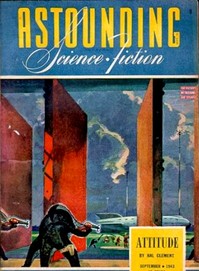
The term “usuform” is introduced early and becomes the story’s central technical conceit: a robot that can reshape itself into any useful form, rather than being limited to a humanoid chassis. This idea drives both the plot and the story’s visual imagination. The narrator describes converting an android’s hand into a gun barrel, replacing one hand “by the chamber and barrel and attaching the trigger so that it would be worked by the same nerve currents.” The transformation is crude and improvised, but it demonstrates the usuform principle in action. The story repeatedly returns to the physical details of how robots are built and modified—holsters that dent, tools on worktables, the need for diagrams—grounding its speculative technology in tactile, workshop reality.
Kidnapping, Trust, and the Stuck Holster
The middle section shifts to a tense kidnapping scene. The narrator and Quinby are held by an android soldier. Quinby notices the android’s gun is stuck in a dented holster—a small mechanical flaw that becomes the pivot of an escape plan. Quinby’s strategy relies on the android’s vanity (each Robinc android believes it is “the unique best”) and its desire for perfect function. The narrator, freed to repair the holster, works under the android’s watchful hand. The scene is built from precise physical cues: the chain on the narrator’s foot, the sweat on his forehead, the “lousy job” he does converting the android’s arm. Quinby’s plan succeeds not through clever dialogue but through observation of a dented piece of metal.
The Android’s Grin and the Limits of Directness
After the conversion, the android “stretched his face into that very rare thing, a robot grin.” This moment of satisfaction is undercut by the narrator’s earlier observation that androids resent their own imperfections. The android’s joy is real, but it stems from a flaw corrected—a temporary fix. The story’s structure moves from political maneuvering to physical action to a quiet, character-driven resolution. Quinby’s gift for “looking at things straight” solves the immediate problem, but the narrator’s final worry—that Quinby is “too hopeful about looking straight at people”—lingers. The story ends not with a triumphant transformation but with a repaired holster and a robot’s rare smile, leaving the larger political questions unresolved.
Readers should pay attention to the story’s small, concrete details: the dented holster, the narrator’s sweat, the android’s built-in vocabulary. These physical specifics carry more weight than the political speeches. The narrator’s voice—half-cynical, half-affectionate—is the story’s real subject, and his growing attachment to Quinby is traced through offhand remarks rather than declarations. The usuform concept is less a technological prophecy than a device for exploring trust, repair, and the limits of straight thinking.