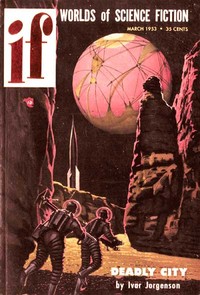
The Salesman — Inside the Classic
Edition facts
The story opens inside Tracy's Department Store, where a blinking green cue light signals a new customer. Trevor Anson, the salesman, adjusts his tie and practices his smile before the elevator doors part. The setting is a near-future retail space, but the focus is not on the merchandise—it is on the ritual of the sale. Anson's movements are choreographed: a wave before a hidden switch, a mental review of the Salesman's Guide. The narrative voice stays close to his calculations, noting the customer's red tie and stubborn hair as data points. This is a world where human behavior is read as a series of cues, and every gesture is a tactic.
The Rulebook as Narrative Engine
The story's structure is built around numbered rules from the Salesman's Guide. Rule 2 declares the customer is always right; Rule 23 advises showing marked-down merchandise first; Rule 31 instructs picking the decision-maker in a family group. These rules are not just background—they drive the plot. Anson's internal monologue is a constant check against the guide, and when he cannot recall an applicable rule, he feels a moment of panic. The rules create a rhythm of action and reflection, turning the sales pitch into a kind of algorithm. Yet the story also hints at the limits of this system: the customer's wife, Millicent, is dismissed as a non-factor, but her presence complicates the transaction.
Color-Coded Signals and the Gray Room
Recurring visual cues organize the story's movement. The green cue light blinks three times to indicate a difficult customer. Anson leads the couple into the Gray Room, a space named for its neutrality, where last year's models are displayed. The color gray suggests a staging area, a place of transition before the real sales pitch. Later, the narrative shifts to other rooms, but the Gray Room is where the initial tension is established. The wife's hat is compared to a comb on a Rhode Island Red—a small, vivid image that stands out against the sterile department store. These details anchor the reader in a physical space that is both generic and strangely specific.
The Customer as Adversary and Puzzle
The red-tied husband is described as aggressive, stubborn, and prone to dramatic muttering. He interrupts Anson's memorized sales talk with complaints about robots running amok. His wife, Millicent, is timid but persistent. The dynamic is a familiar one: the reluctant buyer, the eager spouse, the salesman caught between them. But the story treats this as a puzzle to be solved through rules and observation. Anson notes the man's conservative dress and flaming tie, classifying him as an aggressive type. The narrative never steps outside Anson's perspective, so the customer remains a set of traits to be managed. This limited viewpoint creates a claustrophobic sense of a transaction where genuine connection is impossible.
Movement Between Scenes and the Unseen Sale
The excerpts show a clear pattern of movement: from the elevator to the Gray Room, then presumably to other display areas. Each transition is marked by a new tactic or rule. But the full story likely contains additional shifts—perhaps to a negotiation room or a demonstration area. The structure suggests a journey through the store, with each step bringing Anson closer to a close. However, the excerpts cut off before the sale is completed, leaving the outcome uncertain. This incomplete view mirrors the salesman's own uncertainty: he follows the rules, but the customer's resistance is unpredictable. The story's movement between scenes becomes a metaphor for the precarious balance between script and improvisation.
Readers should pay attention to how the story uses the Salesman's Guide not just as a prop but as a structural device. The rules appear at key moments, shaping Anson's decisions and the narrative's pace. The color cues—green lights, gray rooms—create a visual shorthand for the sales process. And the limited perspective, confined to Anson's thoughts, leaves the customer's inner life opaque. This is a story about the performance of selling, where every gesture is calculated and every word is part of a script. The question is whether the script can hold.