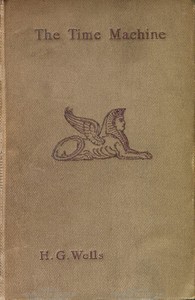
The Time Machine — Text and Context
Edition facts
From the opening paragraph, H. G. Wells establishes a frame narrative that contrasts the comfortable, gaslit Victorian drawing-room with the vast, unknown future the Time Traveller will explore. The narrator describes the fire burning brightly, the incandescent lights, and the luxurious after-dinner atmosphere, while the Time Traveller expounds on the fourth dimension. This setting recurs at the end, creating a structural symmetry that underscores the journey's impact.
The Frame as a Structural Anchor
The narrative is bookended by the Time Traveller's return to his own era. The first chapter introduces the skeptical guests—Filby, the Psychologist, and a very young man—who challenge the Traveller's ideas. Their presence grounds the fantastic tale in a recognizable social setting. When the Traveller returns, disheveled and changed, the same group reassembles, and the contrast between his harrowing experience and their mundane concerns highlights the story's central tension. This frame structure allows Wells to present the future as a cautionary tale filtered through a Victorian lens.
Recurring Images of Light and Dark
Light and dark function as both literal and symbolic elements. In the future, the Eloi live in perpetual daylight, yet they fear the dark, which brings the Morlocks. The Time Traveller notes that the moon will soon enter its last quarter, making nights darker and the Morlocks more active. He uses matches to reassure Weena, and the act of striking a light becomes a ritual of safety. Conversely, the underground world is described as a place of “pallid bodies” and “filthily cold” touch, where light is absent. This binary reinforces the division between the surface and the underworld.
Movement Between Worlds
The Traveller's physical movement—from the drawing-room to the future, from the surface to the underground—mirrors his intellectual journey. He descends into the well to recover his Time Machine, a passage that is both literal and metaphorical. The text emphasizes his reluctance: “I could not face the mystery” and “I never felt quite safe at my back.” This vertical movement between the Eloi's world and the Morlocks' tunnels structures the middle chapters, with each descent revealing more about the society's decay. The Palace of Green Porcelain serves as an intermediate space, a museum of human achievement now in ruins.
The Role of the Narrator's Uncertainty
Wells uses the Time Traveller's own doubts to shape the narrative. He admits his explanations are speculative: “My explanation may be absolutely wrong. I still think it is the most plausible one.” This self-awareness prevents the story from becoming a simple lecture. The Traveller's observations are filtered through his Victorian assumptions, and he often corrects himself or acknowledges gaps in his knowledge. For instance, he misinterprets the relationship between Eloi and Morlocks until he ventures underground. This layered uncertainty invites readers to question the reliability of any single perspective.
Readers attentive to the interplay between the frame and the future episodes will notice how Wells uses the drawing-room as a baseline for normalcy, making the future's strangeness more vivid. The recurring motifs of light, darkness, and vertical movement are not merely atmospheric but structural, guiding the reader through the Traveller's discoveries. This edition preserves the original chapter breaks, allowing one to observe how each section builds on the last.