Black Silence — Background and Themes
Edition facts
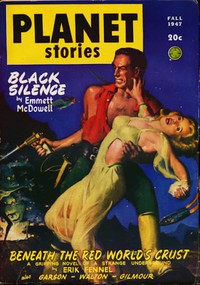
The first expedition to Mars returns to Earth in Emmett McDowell's Black Silence, only to find the planet in the grip of a mysterious plague. The opening excerpt establishes a mood of eager homecoming—crew members discuss baths and fresh air—before a news broadcast announces a rapidly spreading disease characterized by minute black spots and swift death. The broadcast cuts out, and the spaceship's radio goes dead, leaving the crew isolated and anxious.
What follows is not a story of alien encounter but of terrestrial collapse. The excerpts shift to a fortified arsenal on the Ohio River, where the crew must secure a thirty-story fort with machine guns, rocket launchers, and an atomic boiler. The catalog subjects list Science fiction, Space travelers, Epidemics, and Earth (Planet), but the surviving text focuses less on the epidemic itself and more on the logistical challenge of reclaiming a military stronghold.
From Homecoming to Horror
The story opens with a scene of domestic anticipation. Matthew Magoffin, the expedition's palaeobotanist, listens happily to a broadcast from Earth while his colleague Lynn dreams of a real bath. The mood is light, even jovial. Then the music stops. An announcer reports a plague spreading from the Andean region, causing black spots and death within hours. The broadcast cuts off mid-sentence, and the crew's panic is palpable.
McDowell uses the radio as a device to deliver exposition and create tension. The interruption is abrupt, and the silence that follows is the first instance of the titular "black silence." The crew's reaction—Matt rushing to the radio shack, finding no technical fault—suggests a larger, more ominous failure of communication. The plague is described in clinical terms, but the fear is human: the crew realizes they are returning to a world that may no longer be habitable.
A Fortress in the Wilderness
The second excerpt jumps ahead seven months. The crew has landed and is now exploring a massive fort on the Ohio River. The description is meticulous: the muddy Salt River, the disused drive, the heavy steel doors, the machine guns poking through embrasures, the 5.35 dual-purpose anti-aircraft gun, and the banks of rocket guns. The fort has three basements—one for vehicles, one for ammunition, one for an atomic boiler—and thirty floors.
Matt takes charge, issuing orders with military precision: blow up bridges, set up a pillbox, string barbed wire. The language is procedural, almost technical. The crew's mission has shifted from exploration to survival, and the fort becomes a character in its own right—a relic of human preparedness now repurposed for a new crisis. The smell of decay is noted but not dwelled upon; the focus is on functionality.
The Weight of Logistics
McDowell devotes considerable space to the practicalities of securing the fort. Matt orders the chief engineer to restart the atomic engines, a truck to be loaded with explosives, and bridges to be destroyed. The dialogue is brisk and directive: "Tell Sawyer to take two more men and another truck and fortify the highway bridge." There is no time for reflection.
This emphasis on logistics gives the story a grounded, almost procedural feel. The crew is not fighting aliens or exploring new worlds; they are cleaning out a dusty building, checking power plants, and moving equipment. The plague that drove them to this point is mentioned only in passing. The excerpts suggest that Black Silence is less about the epidemic itself than about the human response to catastrophe—specifically, the turn toward militarization and isolation.
The excerpts from Black Silence offer a fragmented view of a story that begins as a spacefaring adventure and narrows to a survivalist siege. Readers should note that the surviving text is incomplete; the full novella may develop the plague, the crew's internal conflicts, or the fate of Earth's population. What remains is a detailed portrait of a group of people falling back on military discipline and infrastructure in the face of an invisible threat. The title's "black silence" may refer to the dead radio, the plague's spots, or the quiet of a depopulated world.