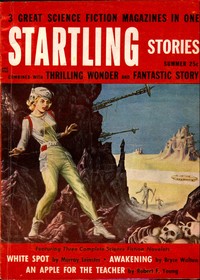
White spot — Edition Insights
Edition facts
The planet in White Spot is introduced not through awe but through practical disappointment: 'It did not look at all encouraging.' The crew of the Danaë must land because their drive failed, and the Interstellar Code requires them to plant crops. The narrative voice is matter-of-fact, detailing the planet's lack of seas, small polar caps, and a puzzling white spot that is not snow. The opening establishes a tone of grim necessity rather than adventure, with the crew's dynamics already strained—Sattell's 'elaborate courtesy' is noted as grating.
The White Spot as a Puzzle
The white spot of the title is first seen from orbit as 'the size of a pin head to the naked eye.' Borden, the captain, examines it with a telescope but cannot discern shadows, ruling out mountains. He photographs it without understanding it. This detail—the inability to interpret a visual anomaly—recurs in the story. Later, the white spot is linked to a buried fleet of alien vehicles, preserved by clay from melting ice. The spot is not merely a landmark but a clue to the planet's hidden history. The narrative treats it as a scientific mystery, not a supernatural one, consistent with Leinster's hard-SF approach.
Alien Technology and Human Tensions
The crew discovers golden-metal weapons and vehicles left by an extinct civilization. Jerry, the youngest crew member, befriends the native bipeds and learns to drive a 'land cruiser' that runs 'with astonishing smoothness.' The technology is advanced but decaying: vehicles are half-buried in clay, and skeletons are found. Borden buries the remains 'together,' a small gesture of respect. Meanwhile, Sattell, the antagonistic crewmate, steals a vehicle and the ship's star maps. The conflict is not with aliens but with human treachery, as Borden plans to track Sattell using a cardiograph to detect lies.
Survival and Moral Choices
The crew's primary goal is survival: repairing the drive and growing food. But the excerpts show them becoming 'absorbed in the operation of a local vehicle' despite being 'shipwrecked on an inimical planet.' This absorption suggests a shift from desperation to curiosity. Borden's decision to bury the skeletons and disable the other vehicles shows a pragmatic morality. The story avoids clear-cut heroism; even Jerry's diffidence is described as 'tolerable.' The ending is not provided, but the setup implies a chase across the planet, with the white spot as a silent witness to both alien extinction and human conflict.
The excerpts of White Spot reveal a story that balances technical problem-solving with interpersonal drama. Readers should pay attention to how Leinster uses the planet's environment—the ice, the clay, the white spot—as both obstacle and clue. The narrative does not rely on exotic aliens but on the crew's reactions to the unknown. The incomplete text leaves the resolution of Sattell's betrayal and the fate of the alien technology uncertain, inviting speculation.